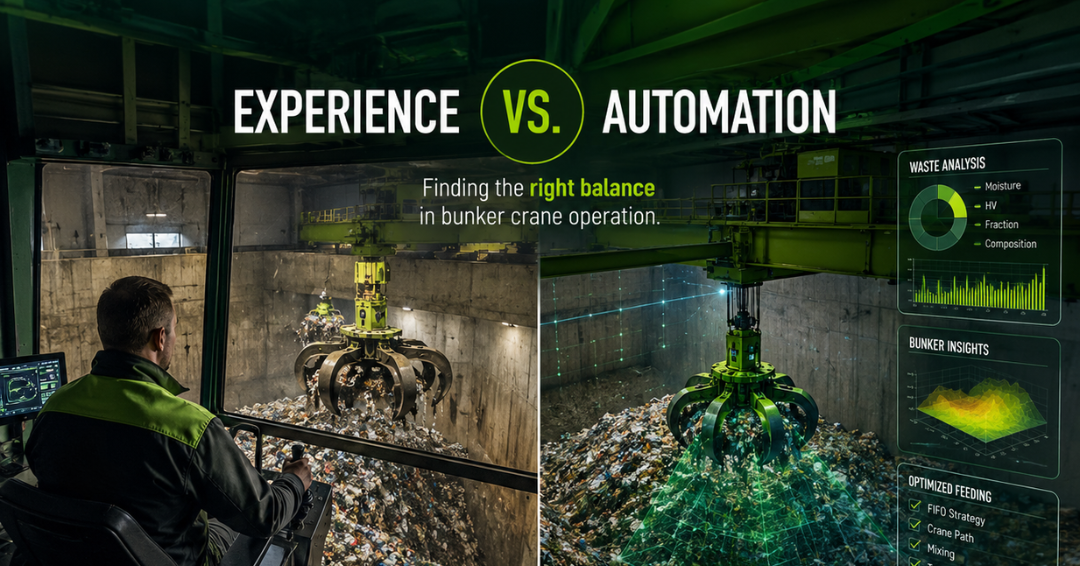
Can an automated crane system completely replace an experienced crane operator? This question is becoming increasingly relevant for operators of Waste-to-Energy plants. Cameras, sensors and AI-supported analytics can now provide information that was not available only a few years ago. Automated systems can plan crane movements, document material flows and support waste feeding strategies.
At the same time, experienced crane operators possess a deep understanding of the bunker that has often been developed over many years. They recognise changes in waste quality, react to unusual situations and continuously make decisions that can influence material mixing and, ultimately, combustion performance.
For many operators, highly or fully automated crane control is a clear long-term objective. The key question is therefore not necessarily whether crane operations should be automated, but how the transition can be implemented safely, gradually and with the lowest possible operational risk. A digitally supported crane operator can represent an important intermediate step on the path towards full automation.
A Waste Bunker Is Not a Homogeneous Storage Area
Municipal and commercial waste is a heterogeneous fuel. Its composition, moisture content, bulk density and calorific value can vary significantly—not only between individual deliveries, but also across different areas of the bunker.
The crane therefore performs far more than a simple transport function between the bunker and the feed hopper. Waste is relocated and mixed to prepare a more consistent material feed.
Technical guidance on waste incineration also identifies waste mixing within the bunker, as well as the detection and separation of unsuitable or problematic materials, as important elements of waste handling.
This makes crane operation an important link between waste delivery and combustion. Decisions made inside the bunker can influence which material properties reach the grate minutes or hours later.
What Experienced Crane Operators Do Particularly Well
An experienced crane operator does not simply assess individual data points. Instead, they combine visual observations with knowledge of the plant, current deliveries, previous shifts and the behaviour of the combustion process.
Their strengths typically include:
This type of practical knowledge can only be translated into fixed rules to a limited extent. Many decisions are based on the interaction of numerous small observations, whose relevance depends on the specific operating situation.
This is one of the main challenges associated with full automation: a system can only consider information that is captured, processed and represented within its decision-making logic.
However, this challenge does not fundamentally argue against full automation. Instead, it highlights which data, models, safety mechanisms and operational knowledge must first be incorporated into an automated system.
Where Automation Demonstrates Its Strengths
Humans are particularly effective at assessing new and complex situations. Automated systems, on the other hand, are strong when large amounts of data need to be processed continuously and according to consistent criteria.
A data-driven crane control system can, for example:
A study published in 2024 on an AI-supported crane system at a Japanese Waste-to-Energy plant demonstrates that a high degree of automation is technically possible.
The system used image analysis to distinguish between different waste conditions and achieved an automated operating rate of approximately 90% during a six-day demonstration period, without any apparent negative impact on combustion stability.
At the same time, the researchers emphasised that visual inspection and the practical experience of crane operators had previously been essential to plant operation.
Although this result is promising, it cannot automatically be transferred to every facility. Bunker geometry, waste composition, crane technology, plant strategy and the availability of data can differ considerably between plants.
For operators, this means that full automation can be a realistic objective, but it must be adapted to the technical and operational conditions of the individual plant.
Why the Transition Towards Full Automation May Be Gradual
A high level of automation should never be an end in itself. The decisive question is whether it creates measurable operational value and works reliably alongside existing processes.
Moving directly from predominantly manual operation to fully autonomous crane control can involve technical and organisational risks. Automated decisions must first be validated under real operating conditions. Responsibilities, opportunities for intervention and the system’s behaviour in unusual situations must also be clearly defined.
A gradual approach allows data quality, models and control logic to be continuously tested and improved. Recommendations can initially be reviewed by experienced crane operators before the system is given increasing levels of responsibility. This makes it possible to identify deviations and incorrect decisions early without exposing ongoing plant operations to unnecessary risk.
The US National Institute of Standards and Technology emphasises, in the context of human-centred technology development, that users and their actual needs should remain central throughout the development and improvement process.
The European Commission's concept of Industry 5.0 similarly does not aim to replace employees as extensively as possible. Instead, digital technologies should support people, expand their capabilities and make industrial processes more resilient and sustainable.
For waste bunker operations, this can mean an initial transition phase in which automation provides information and recommendations, takes over repetitive tasks and demonstrates its reliability during normal plant operation. As the system matures, the level of automation can then be increased further—potentially up to highly or fully autonomous operation.
A Possible Intermediate Step: The Digitally Supported Crane Operator
The digitally supported crane operator is therefore not necessarily the final objective. For many existing plants, however, this model can provide a controlled and lower-risk transition towards full automation.
The system continuously analyses the bunker, documents material movements, identifies patterns and recommends suitable actions. The crane operator monitors the process, evaluates exceptions and intervenes whenever the operating situation requires a different decision.
During this phase, the operator’s experience can be used to validate recommendations, improve the system’s logic and transfer plant-specific knowledge into the automation process. At the same time, the system collects the data and operational experience required to expand autonomous control at a later stage.
The International Society of Automation also highlights that data analytics and AI should primarily help industrial teams combine knowledge from different areas and make better decisions.
For the transition towards a higher level of automation to work effectively, plant operators should answer five key questions before introducing crane automation:
Automation should not begin with the technology itself. It should begin with a clearly defined operational objective.
2. What Information Does the System Need?
Camera images alone may not capture every relevant material property or operating condition.
3. Are the Results Understandable?
Especially during the introduction and validation phase, operators should be able to understand the data and logic behind the system's decisions.
4. When and How Can the Operator Intervene?
Responsibilities and options for manual intervention must be clearly defined, particularly for exceptions, malfunctions and safety-relevant situations.
5. How Will Success Be Measured?
Relevant indicators could include the automation rate, feeding consistency, the number of manual interventions or changes in selected combustion parameters.
As the automation rate increases, operators can also assess which situations still require human intervention and what conditions must be met to reduce these interventions further.
Conclusion: A Gradual, Data-Driven Path Towards Full Automation
Crane automation in Waste-to-Energy plants should not be viewed as a competition between people and machines.
Automated systems offer consistency, continuous data analysis and reproducible processes. Experienced crane operators contribute contextual knowledge, flexibility and sound judgement.
For many operators, full automation may be the long-term objective. However, the transition does not have to take place in a single step. An initially digitally supported operating model makes it possible to validate systems under real conditions, incorporate operational knowledge and reduce technical and operational risks in a controlled manner.
At WasteAnt, our approach is therefore clear: data and AI should initially provide better foundations for decision-making and gradually take over more operational tasks. As the system becomes more reliable in recognising and managing different operating situations, the level of automation can continue to increase.
The digitally supported crane operator is therefore not necessarily an alternative to full automation. Instead, this model can represent an important development stage on the path towards it.
How far has crane automation progressed at your plant—and what conditions would need to be met before fully autonomous operation becomes possible?

Wir entwickeln KI-basierte Lösungen zur Analyse und Bewertung unstrukturierter Abfallströme. Unser Ziel ist es, Transparenz zu schaffen, Prozesse zu optimieren und Abfall als wertvolle Ressource nutzbar zu machen.

Kofinanziert von der Europäischen Union.
Das Forschungsprojekt "Differenzierung von biogenem und fossilem CO2" und das Kooperationsprojekt "Optimierte Regelung von Müllverbrennungsanlagen" werden gefördert von der BAB und der Senatorin für Wirtschaft, Häfen und Transformation.