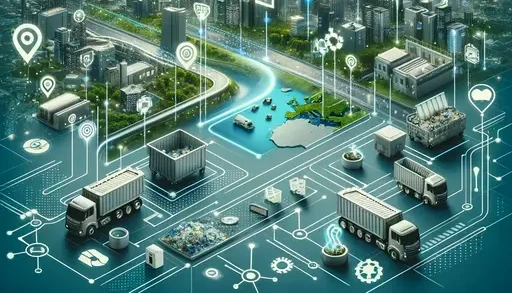
The rise of Artificial Intelligence (AI) and innovative technologies is transforming waste management worldwide, marking a significant shift toward greater sustainability and efficiency. Looking at the global landscape, it becomes clear that these developments are not isolated experiments but part of a broader movement toward smarter and more sustainable waste management solutions.
Global Adoption of AI in Waste Management
Around the world, countries are implementing AI to address waste management challenges, each bringing its own approaches and solutions. Across Europe, for example, AI-powered systems are being used to improve recycling efficiency, enabling machines to sort waste more accurately and faster than ever before. In parts of Asia, AI is being applied to optimize waste collection routes, reducing fuel consumption and lowering emissions.
In the United States and Canada, organizations are exploring the potential of AI to improve landfill operations. Drones equipped with AI technology are being used to monitor and manage waste deposits, ensuring optimal use of landfill space while reducing environmental impact. In Australia, AI is being deployed to combat marine litter, with autonomous drones identifying and collecting waste from waterways.
Good to Know
Several projects run by non-governmental organizations, such as "The Ocean Cleanup Project", already use AI-based tools to address the growing challenge of plastic pollution in the oceans. The organization combines AI and remote sensing technologies to locate and collect plastic waste more efficiently. By using AI, regions with high concentrations of marine debris can be identified quickly and accurately.
Success Stories of International Collaboration
The integration of AI into waste management has been supported by numerous examples of international cooperation and technology transfer. One notable example is the partnership between the European Union and India, where European smart-city initiatives have introduced AI-powered waste sorting technologies to improve waste separation and recycling rates in Indian cities.
Another important example is the Global Waste to Energy Research and Technology Council (GWERTC), which brings together experts from around the world to exchange knowledge and advancements in waste-to-energy technologies. AI plays a key role in optimizing processes and increasing energy recovery efficiency within these initiatives.
Areas for Further Improvement
Despite these advancements, several challenges remain. The standardization of AI applications across different countries is essential to ensure interoperability and scalability. In addition, increasing public awareness and participation in AI-driven waste management initiatives is critical for long-term success.
Continued investment in research and development is equally important to overcome technical limitations and unlock new innovations capable of addressing the growing complexity of waste management in a sustainable manner.
Conclusion
The global adoption of AI and innovative technologies in waste management represents a promising shift toward more efficient and sustainable practices. Through international collaboration and continued investment in emerging technologies, significant progress can be expected in the years ahead, contributing to a cleaner and more sustainable world.
By sharing success stories and continuously addressing areas for improvement, the potential of AI to revolutionize waste management continues to grow, creating new opportunities for innovation and a better future for our planet.

Wir entwickeln KI-basierte Lösungen zur Analyse und Bewertung unstrukturierter Abfallströme. Unser Ziel ist es, Transparenz zu schaffen, Prozesse zu optimieren und Abfall als wertvolle Ressource nutzbar zu machen.

Kofinanziert von der Europäischen Union.
Das Forschungsprojekt "Differenzierung von biogenem und fossilem CO2" und das Kooperationsprojekt "Optimierte Regelung von Müllverbrennungsanlagen" werden gefördert von der BAB und der Senatorin für Wirtschaft, Häfen und Transformation.